

Black Friday 2026 is Friday, November 27. Here is what to expect, when sales really…
How to Tell If a Black Friday Deal Is Actually a Deal
A Black Friday deal is real when the sale price is clearly lower than what the same item has sold for over the past few months, once you include shipping and account for the return policy. The percent-off badge and the crossed-out “was” price tell you very little on their own.
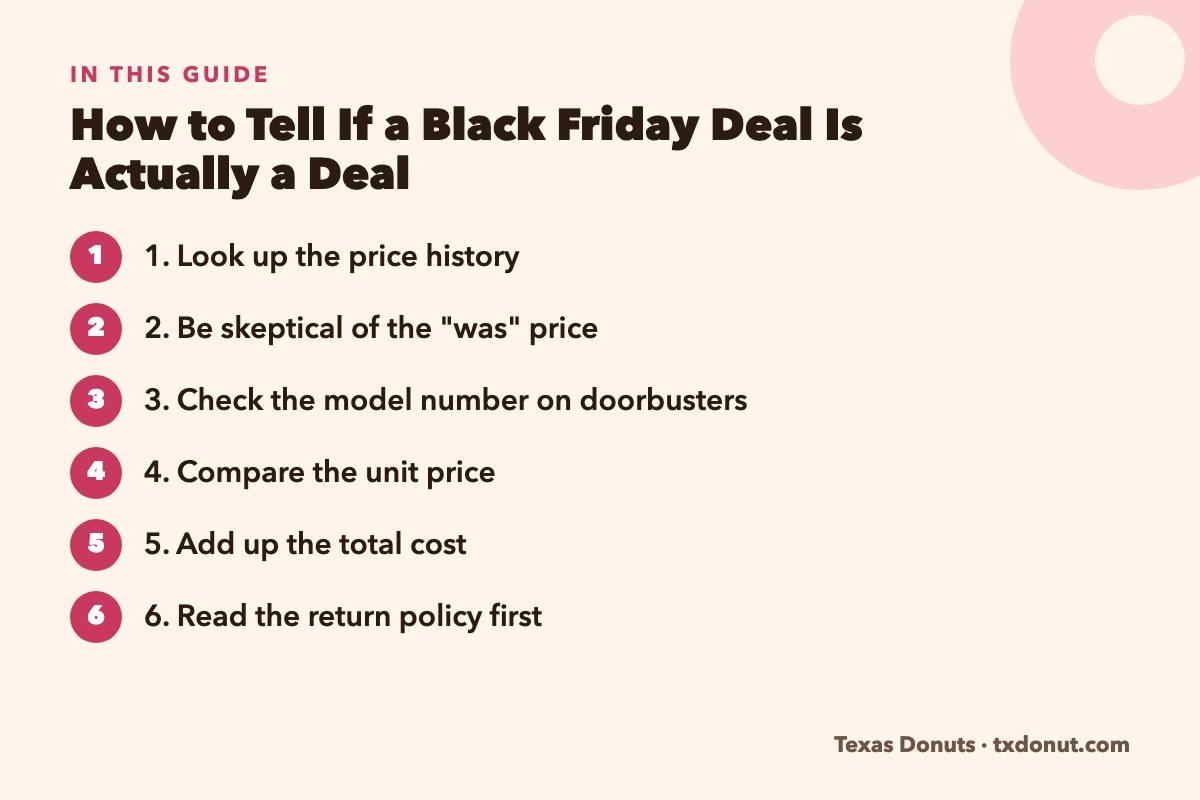
These seven checks take a few minutes per item and catch most of the tricks.
1. Look up the price history
The most reliable test is what the item has cost over time. Price-tracking tools exist as websites, browser extensions, and features inside some shopping apps. They chart an item’s price at certain online retailers over weeks or months and can alert you when it drops to a number you choose.
What to look for on the chart:
- A flat line with a sudden spike, then a “sale.” The price was raised shortly before being discounted back to normal.
- Frequent dips to the same price. The item goes on sale often, so there is no urgency.
- A true low. The current price is at or near the lowest point on the chart. That is a real deal.
No tool covers every store. For items the trackers miss, write down the price yourself in the weeks before Thanksgiving. Even two or three data points beat none.
2. Be skeptical of the “was” price
The crossed-out number is often a list price or manufacturer’s suggested retail price that few people ever paid. A product “60% off” a price it never sold at is not 60% off anything meaningful.
Instead of asking how big the discount is, ask how the sale price compares with:
- The typical selling price over the last few months
- The current price at two or three other retailers
- The price of a comparable product from a competing brand
If everyone is selling it within a few dollars of the “sale” price, that is simply the going rate.
3. Check the model number on doorbusters
Some products, televisions and laptops in particular, appear around the holidays under model numbers that are hard to find at other times of year. Manufacturers sometimes produce variants for specific retailers or sales events. These can be fine products, but they may differ from the brand’s regular line in ways the ad does not highlight, such as fewer ports, a different panel, less memory, or a simpler remote.
How to check:
- Find the full model number in the ad or listing, not only the brand and screen size.
- Search that exact number. If it shows up at only one retailer and has few or no independent reviews, treat it as an unknown.
- Compare the specification sheet line by line against the brand’s standard model.
- Decide based on the specs, not on the brand name alone.
A no-frills variant at a low price can still be a good buy. You only want to know what you are getting.
4. Compare the unit price
Bundles and multipacks make comparison harder on purpose. Divide the price by the quantity to get a per-unit figure: per ounce, per count, per piece.
| Offer type | What to calculate |
|---|---|
| Multipack of batteries, diapers, or coffee pods | Price divided by count |
| Cookware or knife “piece” sets | Price divided by the pieces you will actually use. Lids and utensils often count as pieces. |
| Bundle with accessories | Bundle price minus what you would pay for the main item alone. Is the remainder worth it for the extras? |
| “Buy two, get one free” | Total divided by three, and only if you need three |
Also watch for shrunken sizes. A holiday “value pack” sometimes holds less than the regular package next to it on the shelf.
5. Add up the total cost
The price on the listing is rarely the final number. Before you compare two offers, total up:
- Shipping and handling, including any oversize surcharge
- Sales tax
- Delivery, installation, or haul-away for appliances and furniture
- Required accessories sold separately, such as cables, mounts, or filters
- Membership fees, if the price is for members only
- Subscription or refill costs over the first year
Be careful with mail-in rebates and store credit counted toward the advertised price. A rebate you forget to submit saves nothing, and store credit only has value if you would shop there again anyway.
6. Read the return policy first
A low price on a final-sale item carries more risk than a slightly higher price you can undo. Before checking out, find out:
- How many days you have, and whether there is an extended holiday return window
- Whether doorbuster or clearance items are excluded
- Whether opened items carry a restocking fee
- Who pays for return shipping
- Whether the refund is to your original payment method or store credit
- Whether the seller is the retailer itself or a third-party marketplace seller with its own rules
7. Use price matching and price adjustments
Some retailers match a competitor’s lower price on an identical item, and some will refund the difference if their own price drops within a set period after you buy. Policies vary widely, and many exclude doorbusters, limited-quantity offers, marketplace sellers, or the Thanksgiving weekend itself.
To use these policies well:
- Read the retailer’s written policy before the sale starts.
- Make sure the model number matches exactly.
- Take a dated screenshot of the lower price.
- Keep your receipt or order number handy and ask promptly.
A 60-second deal test
- Would I buy this at full price in the next three months?
- Is the sale price below its recent typical price?
- Is this the standard model, or do I understand the differences?
- What is the total with shipping and tax?
- Can I return it?
Five yes answers means buy with confidence. A no on the first question means it is not a deal for you, however good the price looks. The same rule applies to a second dozen donuts: half price only helps if you were going to eat them.
Related Reading
Frequently Asked Questions
Are Black Friday deals really cheaper?
Some are and some are not. The only reliable way to know is to compare the sale price with the item’s price history and with current prices at other retailers.
How do I check the price history of a product?
Use a price-tracking website, browser extension, or shopping app feature that charts an item’s price over time. For stores those tools do not cover, record the price yourself in the weeks before the sale.
What are Black Friday derivative models?
They are product variants, often TVs or laptops, made for particular retailers or sales events under their own model numbers. They may differ from a brand’s regular models, so compare the specifications before buying.
Do stores price match on Black Friday?
Some do, but many policies exclude doorbusters, limited-quantity items, or the Thanksgiving weekend. Read the retailer’s written price match policy before you shop.