
Twenty-five copy-and-paste AI prompts for marketing, customer service, hiring, finance, and planning. They work in…
How to Use ChatGPT to Write a Menu That Sells
A menu is the one piece of marketing every customer reads. Yet most menus are written once, in a hurry, and never touched again. AI chatbots are very good at the tedious parts of menu writing: producing ten versions of a description, tightening wordy ones, and keeping a consistent voice from the first item to the last.
The prompts below work in ChatGPT, Claude, Gemini, or any similar chatbot.
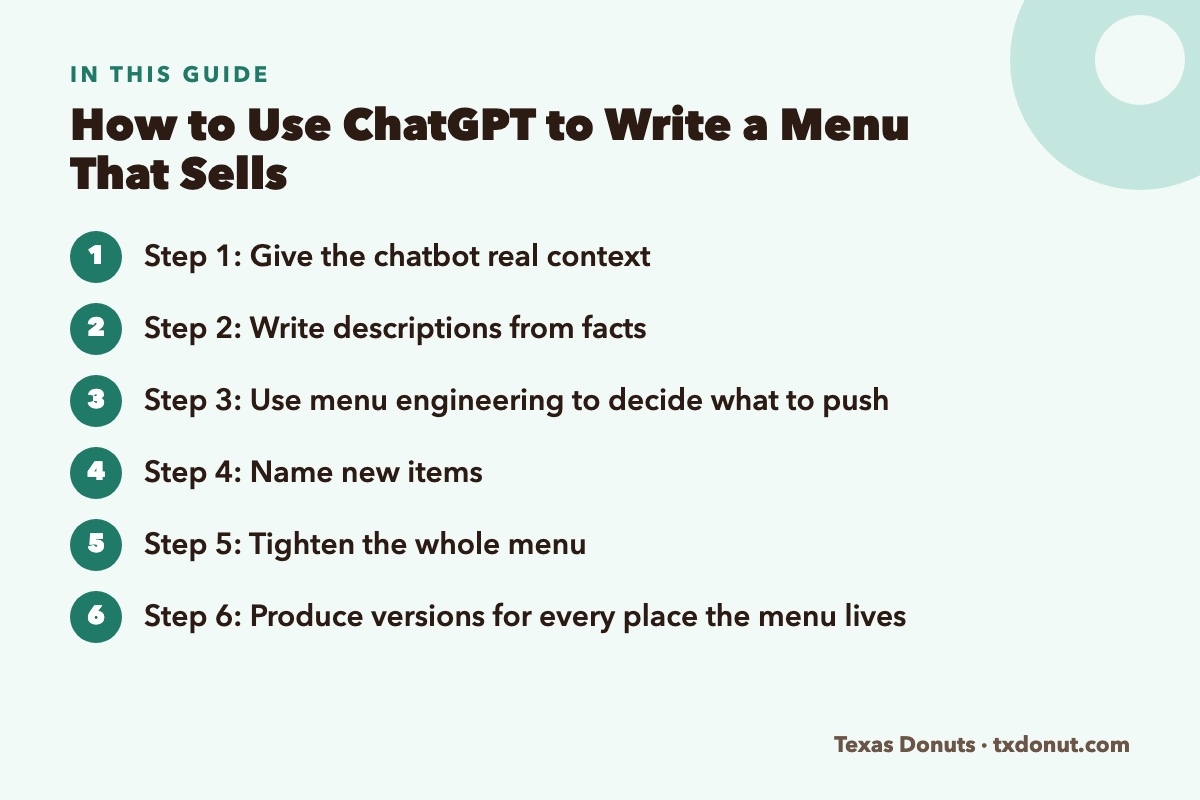
Step 1: Give the chatbot real context
Generic input gets generic output. Before asking for a single description, tell it who you are:
I own a family-run donut and kolache shop in a Dallas suburb. Our customers are commuters, families, and nearby office workers. Our style is friendly and unpretentious. Our best sellers are glazed donuts, sausage-and-cheese kolaches, and apple fritters. I am going to ask you to help rewrite my menu. Keep descriptions under 20 words, concrete, and free of words like “delicious” or “mouthwatering.”
Banning empty adjectives up front is the single most useful instruction. It forces specific details instead.
Step 2: Write descriptions from facts
Give the ingredients and method, and let the chatbot handle the phrasing:
Write three description options for each item. Use only the facts I give you; do not add ingredients or claims.
1. Apple fritter — fresh Granny Smith apples, cinnamon, fried until crisp at the edges, vanilla glaze, made every morning
2. Jalapeño sausage kolache — smoked sausage, fresh jalapeño, cheddar, soft house-made dough
The line “use only the facts I give you” matters. Chatbots happily invent details such as “locally sourced” or “hand-rolled,” and an untrue menu claim is a real problem with customers and regulators alike.
What good menu copy has in common:
- Specific ingredients — “Granny Smith apples,” not “fresh fruit”
- Texture and method — crisp, slow-smoked, fried to order
- Origin, when true — a family recipe, a named local supplier
- Brevity — one line is read; three lines are skipped
Step 3: Use menu engineering to decide what to push
Menu engineering sorts items by popularity and profit into four groups:
- Stars — popular and profitable. Feature them.
- Plowhorses — popular, low margin. Consider a small price increase or a cheaper recipe.
- Puzzles — profitable but slow. Rename, re-describe, or move them where eyes land.
- Dogs — neither. Consider removing them.
A chatbot can do the sorting if you give it data. Export item sales from your POS, add each item’s ingredient cost, and upload the file:
This spreadsheet lists each menu item with units sold last quarter, selling price, and ingredient cost. Calculate the profit per unit and total profit for each item. Classify every item as a star, plowhorse, puzzle, or dog, using the menu average for popularity and margin as the dividing lines. Then give me three specific suggestions for each group.
Step 4: Name new items
Give me 15 name ideas for a new donut: maple glaze, candied pecans, a light dusting of sea salt. Mix straightforward names with a few playful Texas-themed ones. Keep each under four words.
Ask for many and expect to like two. Before printing a name, search for it online to make sure another business nearby is not already using it as a trademark.
Step 5: Tighten the whole menu
Paste the entire menu and ask for an edit:
Here is my full menu. Point out descriptions that are vague, repetitive, or too long. Flag any words used more than three times. Suggest a better order for the categories and for the items within each one, placing my highest-margin items first and last in each section. Do not change prices or add ingredients.
Step 6: Produce versions for every place the menu lives
The same items need different lengths in different places:
For each item, give me: (1) a 15-word version for the printed menu, (2) a 40-word version for our online ordering page, and (3) a one-line Instagram caption.
You can also ask for a Spanish translation, but have a fluent speaker review it before it goes to print. Translation errors on food items are common and sometimes embarrassing.
What not to hand over to AI
- Allergen and dietary statements. Write these yourself from your actual recipes and supplier labels. Never let a chatbot decide whether something is nut-free or gluten-free.
- Health claims. “Low-calorie” and “healthy” carry legal meaning. Leave them out unless you can support them.
- Prices. AI can analyze margins, but the pricing decision depends on your market and your customers.
- The final read. Read every line aloud before it is printed.
A thirty-minute menu refresh
- Paste your context paragraph (5 minutes to write once, then reuse).
- Paste the current menu and ask for the edit in Step 5.
- Rewrite your ten best sellers and five most profitable items with Step 2.
- Read, correct, and print.
You do not need to redo everything. Improving the descriptions of the items you most want to sell is where the return is.

Related Reading
- 25 ChatGPT Prompts Every Small Business Owner Should Save
- How Donut Shops and Bakeries Are Using AI in 2026
- Best AI Tools for Restaurant Owners (Free and Paid)
Frequently Asked Questions
Can ChatGPT write menu descriptions?
Yes. Give it your business context, the real ingredients and preparation for each item, and a word limit. Tell it to use only the facts you provide so it does not invent claims.
What makes a menu description sell?
Specific ingredients, texture and cooking method, true details about origin, and brevity. One concrete line is read; three vague lines are skipped.
What is menu engineering?
It is a method of sorting menu items by popularity and profit into four groups: stars, plowhorses, puzzles, and dogs. You then feature the stars, adjust the plowhorses, reposition the puzzles, and consider removing the dogs.
What should I not let AI write on my menu?
Allergen and dietary statements, health claims, and prices. Write allergen information yourself from your actual recipes and supplier labels, and read every line before printing.