
The most useful AI tools for restaurant, cafe, and bakery owners, grouped by the job…
AI Drive-Thru and Kiosk Ordering: What Small Shops Should Know
If you have pulled into a fast-food drive-thru recently, there is a fair chance the voice that took your order was not a person. The largest chains have spent several years testing AI order-taking, and the results are instructive for anyone running a smaller shop with a drive-thru window or a counter line.
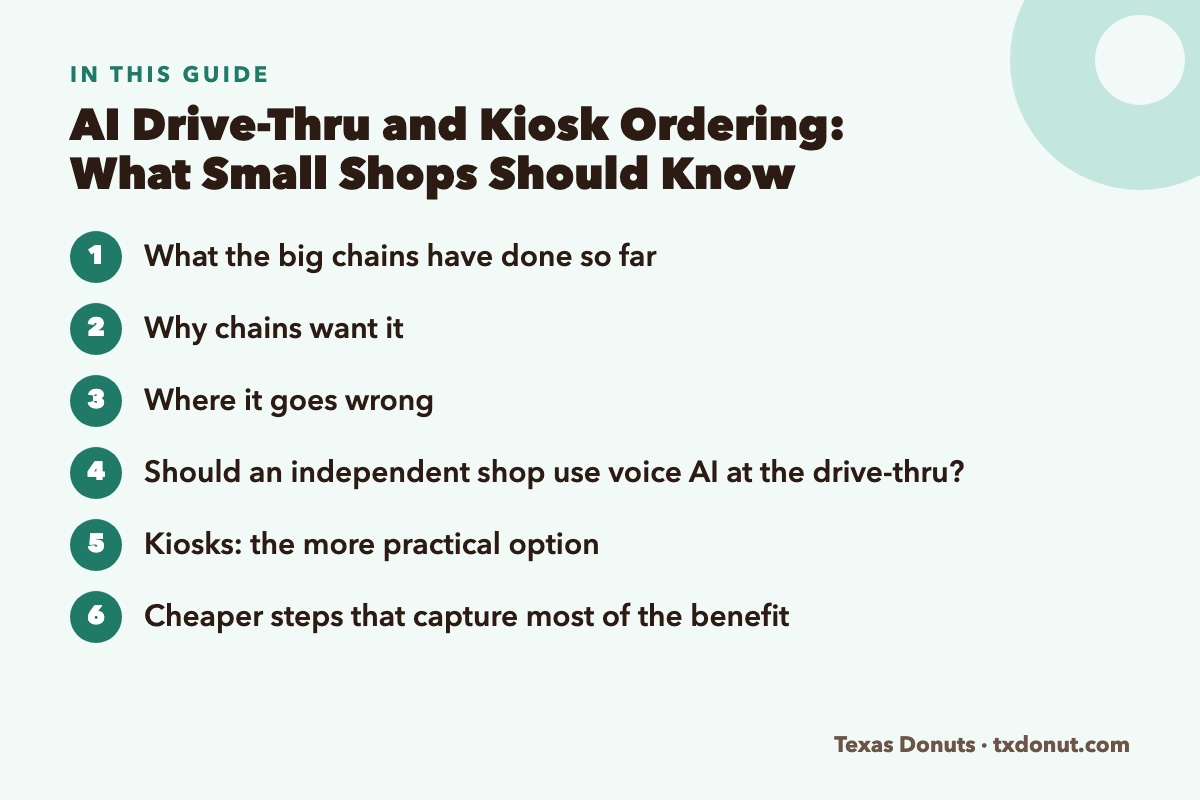
What the big chains have done so far
- McDonald’s tested automated voice ordering with IBM at roughly 100 U.S. drive-thrus and ended that test in 2024. The company has since been reported to be working on a new voice ordering effort with Google Cloud.
- Wendy’s built its FreshAI ordering system with Google Cloud and has been expanding it to more restaurants.
- Taco Bell has gone furthest. Trade publication Nation’s Restaurant News reported in 2026 that its drive-thru voice AI had reached nearly 900 restaurants. The rollout was not smooth: in 2025, clips of the system being confused, including a customer attempting to order 18,000 cups of water, spread widely online, and the company said publicly that it was rethinking where and when AI works best.
The pattern is consistent. The technology works well enough that chains keep investing, and badly enough at the edges that every one of them keeps a human ready to step in.
Why chains want it
- Labor. The order-taker can move to making food or handing out orders.
- Consistency. Software offers the add-on every single time.
- Speed at peak. It never gets flustered when the line wraps around the building.
Where it goes wrong
- Noise. Engines, wind, radios, and children in the back seat all make speech recognition harder.
- Unusual requests. Heavy customization and off-menu asks trip it up.
- Pranks. People test bots in ways they would never test a teenager at a window.
- Customer preference. A share of customers simply dislike ordering from a machine, and say so.
Should an independent shop use voice AI at the drive-thru?
For most single-location shops, not yet. Drive-thru voice systems are built and priced for chains with standardized menus and hundreds of lanes. They need integration with the POS, quality microphones and speakers, and ongoing tuning.
It may be worth a conversation with a vendor if all of these are true:
- Your drive-thru is a large share of sales
- You regularly cannot staff the order position
- Your menu is short and orders are simple
- The vendor integrates with your POS and offers a month-to-month trial
If you do try it, insist on a system where staff can listen in and take over instantly, and tell customers up front that they are speaking with an automated assistant.
Kiosks: the more practical option
Self-order kiosks are a much easier step for a small shop. They are sold by the major POS companies, including Square, Toast, and Clover, and they run on the menu you have already built.
What kiosks do well
- Raise the average order. The screen suggests a drink, a side, or the next size up on every order. Operators commonly report larger tickets on kiosk orders than at the counter, though the size of the effect varies by concept.
- Shorten the line. One cashier plus one kiosk moves more people than one cashier.
- Improve accuracy. The customer enters the order and sees it before paying.
- Help in multilingual neighborhoods. A kiosk can offer the menu in several languages.
What to think through first
- Counter space and flow. Where will people stand while they order, and where will they wait?
- Cash customers. Most kiosks are card-only, so keep a staffed register.
- Accessibility. Screen height, text size, and an easy way to ask a person for help all matter, and accessibility requirements apply to kiosks as they do to the rest of your shop.
- Your regulars. If the morning chat at the counter is part of why people come, do not remove it. Add the kiosk as a second line, not a replacement.
Cheaper steps that capture most of the benefit
- Online ordering with pickup. Customers order from their phone and skip the line entirely. Most POS systems include this.
- QR code ordering. A code on the door or in the drive-thru lane opens your ordering page.
- A drive-thru menu board that sells. Put your most profitable combos at eye level and train staff to ask one specific add-on question.
- Pre-orders for dozens and catering. Take large orders the day before so they do not jam the morning line.
The takeaway
Drive-thru voice AI is real and improving, but it remains a chain-scale technology with visible rough edges. Independent shops get more value today from kiosks and online ordering, which deliver the same core benefits of faster lines, consistent upselling, and fewer errors at a fraction of the cost and risk. Watch what the big chains learn, and let them pay for the learning.
Related Reading
- AI Phone Ordering for Restaurants: Is It Worth It?
- Best AI Tools for Restaurant Owners (Free and Paid)
- AI Employee Scheduling Tools: Do They Actually Save Money?
Frequently Asked Questions
Do AI drive-thrus actually work?
They work well enough that large chains keep expanding them, but they still struggle with noise, unusual requests, and pranks. Every chain using them keeps staff available to take over.
Should a small shop install AI voice ordering in its drive-thru?
For most single-location shops, not yet. These systems are built and priced for chains with standardized menus. Kiosks and online ordering deliver similar benefits at lower cost and risk.
Do self-order kiosks increase sales?
Operators commonly report larger orders at kiosks because the screen suggests add-ons every time. The size of the effect varies by concept, so compare your own average ticket before and after.
What is the cheapest way to speed up a drive-thru line?
Offer online ordering with pickup, post a QR code that opens your ordering page, and take large orders such as dozens and catering as pre-orders the day before.