

A realistic look at what AI costs a small business, from free tools to several…
AI Business News Roundup: What Changed This Month for Small Businesses (November 2026)
AI news arrives faster than anyone running a business can follow. Most of it does not affect a shop with ten employees. This monthly roundup keeps only the items that might, and says what each one means in practice.
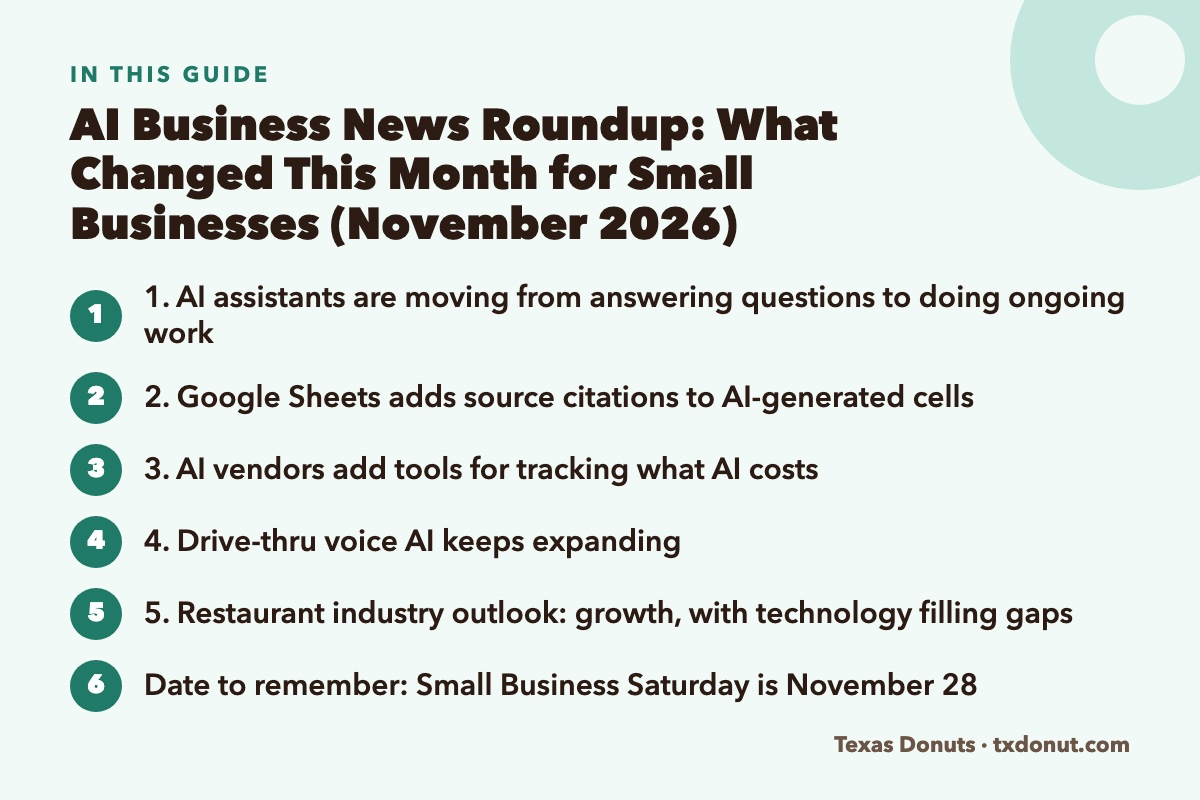
1. AI assistants are moving from answering questions to doing ongoing work
What happened: Perplexity was reported to have announced “Teammates” in early November, AI agents designed to own a continuing task rather than wait for a prompt. It follows similar agent features from the other major AI companies over the past year.
What it means for you: The direction across the industry is clear: assistants that monitor an inbox, track a competitor’s prices, or prepare a weekly report without being asked each time. For a small business, the first useful jobs are routine and low-risk, such as a Monday summary of last week’s sales and reviews.
What to do: Pick one recurring report you build by hand and see whether your current AI tool can now produce it on a schedule. Keep a human approving anything that sends money or messages customers.
2. Google Sheets adds source citations to AI-generated cells
What happened: Google announced in late October that AI-generated content in Sheets cells can show the web sources it drew on.
What it means for you: If you use AI in a spreadsheet to look up supplier details, competitor pricing, or market data, you can now see where a figure came from and check it. That addresses the biggest weakness of AI research, which is confident answers with no trail.
What to do: When AI fills in a number you plan to act on, click through to the source. If there is no source, treat the number as a guess.
3. AI vendors add tools for tracking what AI costs
What happened: Anthropic was reported to have added project tagging in beta for eligible business customers of Claude in early November, making it easier to see AI usage by project or client.
What it means for you: As AI moves from a single subscription to something several employees use daily, cost tracking becomes a normal part of managing it. Agencies and consultancies in particular can start attributing AI costs to client work.
What to do: List every AI subscription your business pays for, who uses it, and for what. Most owners find at least one to cancel.
4. Drive-thru voice AI keeps expanding
What happened: Trade press reported this year that Taco Bell’s drive-thru voice ordering had reached nearly 900 U.S. restaurants, with the chain continuing its rollout. McDonald’s, which ended an earlier test in 2024, is reported to be working on a new voice ordering system.
What it means for you: Customers are getting used to ordering from an automated voice, which lowers resistance to AI phone answering at independent restaurants. The chains’ public stumbles are also a reminder that these systems need a human backstop.
What to do: If you lose phone orders during rush hours, this is a reasonable time to trial an AI phone assistant in overflow mode, answering only the calls your staff cannot reach.
5. Restaurant industry outlook: growth, with technology filling gaps
What happened: The National Restaurant Association’s 2026 outlook projected industry sales of about $1.55 trillion and more than 100,000 jobs added this year, while noting that operators are leaning on digital ordering, automation, and data analytics for efficiency.
What it means for you: The industry is still hiring while it automates. So far, AI in restaurants looks more like help for short-staffed teams than a replacement for them.
What to do: Aim your first AI project at a task your team dislikes or cannot keep up with, such as phones, invoice entry, or scheduling.
Date to remember: Small Business Saturday is November 28
The Saturday after Thanksgiving is the biggest shop-local day of the year in the United States. A one-hour AI-assisted plan is enough to be ready:
- Ask a chatbot for five offer ideas suited to your business, and pick one.
- Have it draft three social posts, one email, and a counter sign.
- Update your Google Business Profile with holiday-weekend hours and a post about the offer.
- Schedule everything by the weekend before.
The pattern this month
Three themes run through these items. AI tools are becoming more autonomous. They are becoming more accountable, with citations and usage tracking. And customers are meeting them in everyday places like the drive-thru. None of this demands urgent action from a small business, but each makes the practical uses of AI a little easier to trust and to manage.
This roundup is updated monthly. Product details change quickly, so confirm features and availability with each company before making a decision.
Related Reading
- 10 Best AI Tools for Small Business Owners in 2026
- ChatGPT vs Claude vs Gemini: Which Is Best for Small Business?
- How Much Does AI Really Cost a Small Business? A Realistic Budget
Frequently Asked Questions
What AI news matters most to small businesses this month?
AI assistants are taking on ongoing tasks rather than single questions, AI tools are adding source citations and usage tracking, and automated voice ordering is becoming more common in restaurants.
Should a small business act on every new AI announcement?
No. Most announcements do not affect a small business right away. Look for changes to tools you already use and for features that solve a problem you already have.
When is Small Business Saturday in 2026?
Small Business Saturday falls on November 28, 2026, the Saturday after Thanksgiving.
How often is this roundup updated?
Monthly. Product details change quickly, so confirm features and availability with each company before making a decision.